In one sentence: The safe working load (SWL) is the maximum certified load an FIBC may carry in service, while the safety factor (SF) describes the relationship between that rated load and the final load reached in a specified test—it is not permission to overload the bag.
That distinction matters. A 1,000 kg FIBC marked with a 5:1 safety factor is still a 1,000 kg working bag, not a 5,000 kg bag. The additional test margin is built into the design and certification process; it is not spare carrying capacity for everyday use. Understanding the FIBC safety factor helps buyers compare service categories without confusing test performance with permitted payload.
The Two Numbers Every Bulk Bag Buyer Should Read
Safe Working Load (SWL)
The FIBC safe working load is the maximum load the bag is certified to carry under its defined service conditions. If the label states “SWL 1,000 kg,” the filled product weight must not exceed 1,000 kg.
The actual order specification also needs to account for product bulk density. A large-volume bag does not automatically have a higher weight rating, and a dense material can reach the SWL before the bag is physically full.
Safety Factor (SF)
ISO 21898:2024 defines safety factor in relation to the final test load achieved during the cyclic top-lift test and the designated SWL. In practical purchasing language, ratings such as 5:1 and 6:1 identify different performance categories and intended service patterns.
The safety factor should never be used as an overload calculation:
Rated capacity = SWL, not SWL × safety factor.
5:1 vs 6:1 FIBC: Quick Comparison
| Marking | Typical service category | Reuse assumption | Buyer takeaway |
| 5:1 | Single-trip FIBC | One filling cycle; reuse is not intended | Use within the marked SWL and dispose of or recover responsibly after the intended trip |
| 6:1 | Reusable or multi-trip category, when designed and certified for it | Limited reuse within a controlled system | Reuse is allowed only under the defined design, inspection and tracking conditions |
Important: A higher safety factor does not automatically make a bag suitable for every repeated-use program. The supplier must design and certify the FIBC for the intended duty, and the user needs a controlled inspection and reuse system.
A Simple Example: The 1,000 kg Bulk Bag
Suppose a buyer orders an FIBC with:
- SWL: 1,000 kg
- Safety factor: 5:1
- Intended service: single trip
- Product: dry granules
The operator may fill the bag with no more than 1,000 kg of product. The 5:1 designation describes test performance relative to the SWL; it does not allow the operator to fill the bag to 5,000 kg.
Now consider a second FIBC marked:
- SWL: 1,000 kg
- Safety factor: 6:1
- Intended service: reusable
Its normal working limit is also 1,000 kg. The difference concerns its design and certified service category, not a higher everyday payload.
Why “It Looks Strong Enough” Is Not a Specification
Two bulk bags with the same dimensions can have different load ratings. FIBC performance depends on the complete construction, including:
- woven polypropylene fabric strength and UV stabilization;
- body-panel or circular-woven design;
- lifting-loop material, width and attachment;
- seam design and sewing pattern;
- top and bottom construction;
- fabric coating or inner liner;
- product distribution inside the filled bag;
- manufacturing control and type-test results.
Visual appearance cannot confirm SWL or safety factor. Buyers should rely on the permanent label, agreed specification, test documentation and supplier instructions.
When Should a Buyer Choose a 5:1 FIBC?
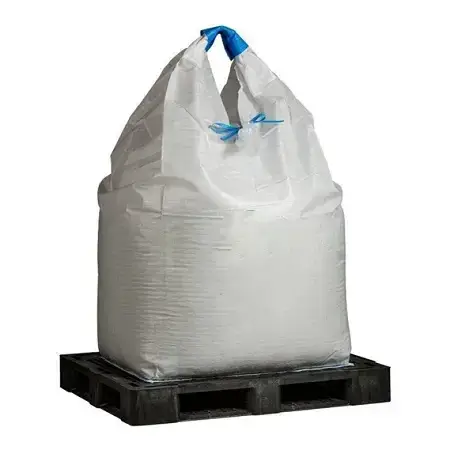
A 5:1 single-trip FIBC is commonly considered when the bag will be filled once, transported through the supply chain and discharged once. Typical applications may include minerals, construction materials, agricultural products, fertilizer, resin and other dry bulk goods.
“Single trip” refers to one filling cycle. The bag may pass through several transport stages during that cycle, but it is not intended to be emptied and filled again.
ZhengYi’s FIBC Bulk Bags product category includes customizable filling, discharge and lifting configurations for different dry bulk applications. For agricultural and industrial materials, buyers can also review the 1000kg Two Loop Bulk Bag. The required SWL and service category should be confirmed in the purchase specification.
When Does a 6:1 Reusable FIBC Make Sense?
A reusable FIBC may be appropriate in a closed or controlled distribution system where:
- The bag was designed, tested and marked for repeated use.
- The product and route remain compatible with the original specification.
- Every trip is recorded.
- The bag is inspected before refilling.
- Cleaning, replacement of removable parts and repairs follow an approved process.
- A damaged or nonconforming bag is immediately removed from service.
A reusable bag should not be chosen only because it sounds more sustainable. If the organization cannot control returns, inspection, contamination and traceability, a multi-trip program may introduce risk instead of value.
Five Errors That Can Defeat the Rating
Error 1: Exceeding the Marked SWL
The most direct error is filling above the certified working load. FIBCA’s safe handling guidance states that the rated capacity must never be exceeded.
Error 2: Using the Wrong Product Density
A bag developed for a low-density material may be unsuitable for a denser product even if both materials fit within the same nominal bag volume. Provide the supplier with the actual bulk density and target net weight.
Error 3: Uneven or Unstable Filling
Poor product distribution can make the filled FIBC unstable. The bag should be filled in a way that supports its designed shape and does not adversely affect stability.
Error 4: Damaged Loops, Fabric or Seams
Cuts, abrasion, UV degradation, pulled stitching, chemical attack or damaged loops can compromise the package. Do not repair a loaded bag with tape or improvise a lifting point.
Error 5: Treating a 5:1 Bag as Reusable
A bag that survived its first trip is not automatically safe to refill. Single-trip status is a design category, not a visual judgment made after discharge.
What Must Be Printed on the Bag Label?
Exact marking requirements depend on the applicable standard, market and application, but a procurement team should expect clear identification of critical information such as:
- manufacturer or supplier identification;
- unique bag or type reference;
- safe working load;
- safety factor or service category;
- relevant handling symbols and warnings;
- traceability or production information;
- electrostatic classification, when applicable;
- dangerous-goods certification marks, when applicable.
Never accept a verbal load rating as a substitute for a durable, legible label and supporting documentation.
What Does ISO 21898:2024 Cover?
ISO 21898:2024 specifies material, construction, design, type-test and marking requirements for FIBCs intended for non-dangerous solid materials in powder, granular or paste form. It also provides guidance on selection and safe use.
The current edition was published in August 2024 and replaced ISO 21898:2004. Buyers referencing the standard in new specifications should identify the correct edition and confirm which tests and documents the supplier will provide.
For dangerous goods, a standard non-dangerous-goods FIBC specification is not enough. The packaging must meet the applicable dangerous-goods rules and be correctly certified and marked for the intended contents and transport mode. Review ZhengYi’s UN Certified FIBC Bag product category and the UN Certified FIBC Jumbo Bag product page, then verify the exact UN packaging requirement before purchase.
Procurement Decision Tree
Will the FIBC be filled more than once?
- No: Specify a single-trip FIBC with the correct SWL, product compatibility and handling design.
- Yes: Continue to the next question.
Can every bag be tracked, inspected and controlled between trips?
- No: Do not assume a reusable FIBC program is appropriate.
- Yes: Define the required reusable category, inspection criteria, maximum trips and rejection process with the supplier.
Is the product classified as dangerous goods or used in a combustible atmosphere?
- Yes: Add the applicable UN transport and/or electrostatic requirements; SWL and SF alone are insufficient.
- No: Specify the relevant non-dangerous-goods standard and service conditions.
RFQ Template for Load Capacity
Copy these fields into your next FIBC request for quotation:
| RFQ field | Information to provide |
| Product | Name, particle form and hazards |
| Bulk density | kg/m³ or lb/ft³ |
| Net fill weight | Maximum product weight per bag |
| Required SWL | For example, 1,000 kg |
| Service category | Single-trip or defined reusable system |
| Standard | Required edition and destination-market rules |
| Bag dimensions | Width × length × height |
| Top and bottom | Open, duffle or spout dimensions |
| Lifting system | Four-loop, one-loop, two-loop or other |
| Handling method | Forklift, crane with approved device, filling station, discharge station |
| Storage | Indoor/outdoor, duration, UV and temperature |
| Documentation | Label sample, specification sheet and test evidence |
Frequently Asked Questions
Does a 5:1 safety factor mean an FIBC can lift five times its SWL?
No. A 5:1 marking is a test-related safety factor, not an operating load multiplier. Never exceed the SWL printed on the label.
Is a 6:1 FIBC always reusable?
It must be specifically designed, tested and marked for reusable service, and reuse must occur within a controlled inspection and tracking system. A number alone should not replace the supplier’s service instructions.
Can a 1,000 kg bulk bag be filled with 1,100 kg?
Not if its marked SWL is 1,000 kg. Order a correctly designed bag with a higher certified SWL rather than overfilling the existing bag.
Can the inner liner be replaced and the bag reused?
Replacing a liner does not convert a single-trip FIBC into a reusable one. Reuse depends on the certified design and service category of the complete FIBC.
Are SWL and safety factor enough to select a bag?
No. Product density, hazards, electrostatic conditions, filling and discharge design, lifting method, UV exposure, transport route and regulatory requirements must also be specified.
Bottom Line
Read the FIBC label in this order: service category, SWL, FIBC safety factor, application warnings and traceability. Keep the filled weight at or below the SWL, and never infer reuse from appearance. The safest purchase is a bag engineered and documented for the actual product, process and number of filling cycles.
To request a recommendation from ZhengYi Packaging, provide the product bulk density, maximum fill weight, intended number of trips, filling and discharge method, destination market and any dangerous-goods or electrostatic requirements. Contact ZhengYi Packaging for a customized FIBC quotation.